
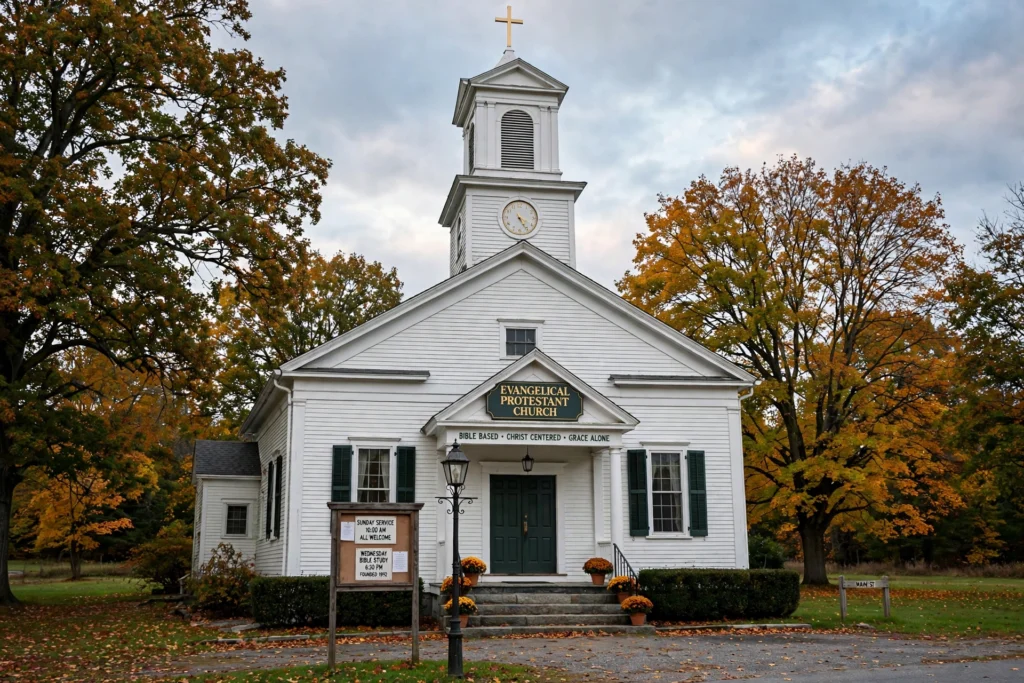
The Coming Tsunami of Church Closings Will Change America, and Evangelical Church Leaders Must Take the Brunt of the Blame
Daniel Whyte III, President of Gospel Light Society International, says the Evangelical intelligentsia and the Evangelical Industrial complex must humble themselves and shoulder the blame for the collapse and the falling away of the once Bible-based Protestant movement in America, as they have led the Protestant church to be more concerned about political power and compromise, changing America instead of the church obeying the Great Commandment, the Great Commission, and the Great Parable by Jesus Christ To This End: “THAT MEN OUGHT ALWAYS TO PRAY AND NOT TO FAINT.” The Evangelical leaders’ strategy of compromise and collusion with politicians and the government has failed God, Jesus Christ, the Church, Government, the nation, and the world, and has made the Judas-Jezebel-Laodicean Evangelical church, the church that Jesus Christ has spewed out of His mouth.
One summer morning, the Rev. Melissa Wagner stepped into the pulpit of her church and delivered a sermon that no pastor ever wants to give.
Wagner fought back tears as she spoke in her stately United Methodist church that had stood in Belding, Michigan, for 120 years. To celebrate their faith and prosperity, the town’s leaders had built a grand edifice with a soaring domed ceiling, massive stained-glass windows and an 8-foot painting of Jesus overlooking the altar.
But on that Sunday in 2024, Wagner spoke to a nearly empty church — about 12 elderly members, sitting far apart from one another in a sanctuary built for a thousand people. There was no choir, no church organist, and no children or young families.
She was delivering a eulogy — not for a person, but for her congregation.
“You are still the church,” Wagner said as one elderly woman dabbed her eyes with tissue. “And while where you worship will change, the one you worship does not.”
Scripture tells us why. “For the time will come when they will not endure sound doctrine; but after their own lusts shall they heap to themselves teachers, having itching ears; and they shall turn away their ears from the truth, and shall be turned unto fables” (2 Timothy 4:3-4). What happened in Belding is not merely demographic. It is theological. It is the bitter fruit of a church that traded the authority of Scripture for cultural relevance, political access, and institutional survival.
Experts now project an estimated 100,000 churches in the US will close or be repurposed over the next decade. One pastor described it plainly: “Every year the pews are getting emptier and the collection plates getting lighter.”
This is the crisis examined by “Christianity at a Crossroads,” a new four-part TV documentary series premiering Thursday on PBS stations. The series features scenes like the last days of Belding United Methodist Church and shows how mass church closures will hurt communities across America — including people who never attend church.
The filmmakers interview a wide range — from the Rev. Robert Jeffress to Democratic Senate candidate Rev. Adam Hamilton to people who attend virtual reality church as avatars. But the shadow over the entire series is the perilous future of the church itself.
From a biblical standpoint, the documentary gets the symptoms right but misses the disease. Church leaders have warned about decline for decades. What is new is the scale and the timeframe. Yet Scripture already gave the diagnosis: when the church ceases to preach “Christ crucified” (1 Corinthians 1:23), when it seeks the favor of princes rather than the power of God, it withers.
There are glimmers the series highlights — thriving immigrant churches like Korean Central Presbyterian Church in Northern Virginia, and Alfred Street Baptist Church in Alexandria, Virginia, with about 10,000 members and 15,000 online viewers. “It’s no longer an in-person church with an online option. It’s an online church with an in-person option,” filmmaker Martin Doblmeier says.
But technology is not revival. Parking lots, lively music, and hospitality do not save souls. Only the Gospel does. “I am not ashamed of the gospel of Christ: for it is the power of God unto salvation” (Romans 1:16).
The film rightly notes that most American churches have been “engines of social good” — food pantries, immigration help, charity. Regular churchgoers donate more, volunteer more, and anchor neighborhoods. When pews go empty, the Rev. Jacqueline J. Lewis says, “In so many neighborhoods, the church is the food pantry, the immigration station.”
That is true, and it is tragic. But the church was never called first to be a social agency. She was called to be the bride of Christ, “the pillar and ground of the truth” (1 Timothy 3:15). When she abandons truth for utility, both are lost.
Consider the Rev. Matt Braddock of Christ Congregational Church in Silver Spring, Maryland. Membership fell below 100 while the sanctuary cost about $400,000 a year to maintain. The stress gave him a migraine that lasted six months. His church closed its building and moved into another church’s basement — and found new life in smallness.
“It was important for me to remind everyone that the church isn’t a building, and it never was,” Braddock says. “It’s the gathering of God’s people.”
He is right about the building. The first Christians met in homes. They did not define the church as property but as “a body of believers.” Yet the deeper question remains: what Gospel is being gathered around? A church can meet in a basement and still be dead if Christ is not preached in power.
Doblmeier thinks churches struggle because “church is the place you go to because you feel as though it’s not changing.” People crave the familiar — the same rhythms, prayers, rituals. There is comfort in stability.
But biblical stability is not nostalgia. It is fidelity. “Jesus Christ the same yesterday, and to day, and for ever” (Hebrews 13:8). The church that refuses to change its methods may die. The church that changes its message will die eternally.
The series spotlights the Church Project in Texas meeting in homes like the early church, and the Church of the Nativity in suburban Baltimore drawing 800 kids on Sundays. “They saw early on that if the children want to come, they will bring their parents,” Doblmeier says.
Children matter. But what will they be taught when they come? Entertainment draws crowds. Only truth keeps souls.
One of American church leaders’ biggest fears is becoming like Western Europe — a post-Christian landscape of empty cathedrals turned into condos. Braddock expresses hope: “People can get together for other reasons, but there’s something important to people with similar spiritual questions and hungers getting together and finding meaning.”
That hunger is real. But meaning without Christ is vanity. The answer is not better marketing. It is repentance.
“And unto the angel of the church of the Laodiceans write… I know thy works, that thou art neither cold nor hot… So then because thou art lukewarm, and neither cold nor hot, I will spue thee out of my mouth” (Revelation 3:14-16).
The tsunami of closings is the Lord’s warning. Evangelical leaders must humble themselves, confess their collusion with political power and cultural compromise, and return to the Great Commandment — “Thou shalt love the Lord thy God with all thy heart” (Mark 12:30) — and the Great Commission — “Go ye therefore, and teach all nations” (Matthew 28:19). Until then, the buildings will keep emptying, because Ichabod has been written over the door: the glory has departed.
___________________________
Daniel Whyte III has been preaching the Gospel for over 46 years. He is the founder and President of the over 42-year-old Gospel Light Evangelistic Society International, Pastor of the over 38-year-old Gospel Light House of Prayer International, and Founder, President, and Editor-in-Chief of the over 22-year-old Black Christian News One (BCNN1.com)—reaching millions with the Gospel of Jesus Christ, discipleship preaching, and the whole counsel of God around the world by any means necessary — “Crying in the Wilderness,” “Exiled on the Isle of Patmos,” and Preaching the Gospel by any means necessary.
Daniel Whyte III was honored by being named one of the 17 most notable alumni in the history of the 134-year-old Texas Wesleyan University in Fort Worth, Texas, and one of the 69 most notable alumni in the history of the 53-year-old Liberty University in Lynchburg, Virginia.
Daniel Whyte III holds the following degrees from these universities:
- Doctor of Ministry (D.Min., in progress) – Liberty University John W. Rawlings School of Divinity, Lynchburg, VA
- Master of Theology (Th.M.) – Liberty University John W. Rawlings School of Divinity, Lynchburg, VA
- Master of Divinity (M.Div.) – Liberty University John W. Rawlings School of Divinity, Lynchburg, VA
- Bachelor of Arts in Religion (B.A.) – Texas Wesleyan University, Fort Worth, Texas
- Bachelor of Theological Studies – Bethany Divinity College and Seminary, Dothan, Alabama (Honors: Summa Cum Laude)
Daniel Whyte III was also honored to sit with presidents and world leaders by being invited by the Billy Graham Evangelistic Association to attend the homegoing of Dr. Billy Graham.
He is the Essence national best-selling author of Letters to Young Black Men and the Amazon best-selling author of Letters to Young Black Women (African-American category). He has authored over 100 books.
He is also the founder, president, and editor-in-chief of the 20-year-old BlackChristianNews.com (BCNN1.com), which has impacted every denomination in the evangelical and Christian world and has influenced presidents, the U.S. government, governments around the world, and the public square. BlackChristianNews.com has been named the #1 Black Christian website and blog in the world for four years running by the independent Feedspot and is on the list of the top 60 Christian news sites in the world—red, yellow, black, or white.
He has preached the Gospel and the Word of God in person across America and in over 24 countries to thousands of people. He has preached the Gospel and the Word of God to millions of people around the world with the help of the internet, preaching live and on-demand multiple times a day for over ten years, to this very day. His mottos are “Crying in the Wilderness,” “Exiled on the Isle of Patmos,” and “Preaching the Gospel by any means necessary,” all for the glory of God and Jesus Christ.
Daniel Whyte III is the president of the over-40-year-old Gospel Light Evangelistic Society International and the over-37-year-old Gospel Light House of Prayer International. He is known worldwide as the prophet who predicted the Coronavirus Plague more than 10 years before it hit, in recorded preaching and writing. God also led him to guide thousands through the Coronavirus Plague that killed over 20 million people because of the sins in the Judas-Jezebel-Laodicean church.
Daniel Whyte III’s greatest blessing in this life is his “quiver full” of 10 children—Daniella (Danni), Daniel IV, Danita Evangeline, Danae Mary-Louise, Daniqua Grace, Danyel Ezekiel, Danyelle Elizabeth Breedlove, Danielle Tekeela, Duran-Daniel, and the first Daniel IV (deceased and in heaven with the Lord)—along with grandchildren and great-grandchildren.
Daniel Whyte III has been unblissfully but sexually satisfyingly married to his first and only wife, Meriqua Whyte of Christiana, Jamaica, for over 37 years since December 19, 1987. Jesus Christ said: “And a man’s foes shall be they of his own household.” Even though many evangelicals, charismatics, and Protestants try to act as if these words of Jesus Christ are not a reality in our modern Christianity—primarily because of the Satanic-driven prosperity gospel and an over-positive philosophy, which is a lie not based in reality or biblical truth—the words of Jesus Christ are true for every person who preaches the Gospel. The outcomes of the Gospel are a changed life and opposition from family, lukewarm Christians, Laodicean-Judas pastors and churches, the world, and the devil. This is a reality in our present evil world.
While Daniel Whyte III thoroughly enjoys his married life because he did not allow his wife to have her way at any point and was and is solidly, and biblically the head of his household throughout the marriage—often quoting Joshua, “As for me and my house, we’re going to serve the Lord” “up in here!”—and because his wife never failed in the very important area of sex, which he got married for in the first place to avoid sinning against God, he has especially enjoyed the privilege and joy of raising his children in the Lord virtually by himself. He served the Lord with them every day of their lives, from the time they were born until they graduated from college, became adults, and moved on.
However, his wife, Meriqua Whyte—motivated by Satan, with a Pharaoh-style pride mixed with the well-known female Jamaican-style pride, stubbornness, rebelliousness, and witchcraft—has been his greatest Judas enemy in the world and has been what Paul spoke of: a “messenger of Satan” and a “thorn in the flesh.” Amazingly, and by the grace of God, that Satanic evil opposition has spurred Daniel Whyte III on to preach the Gospel probably more times than any man on record. God has honored him because he did not “hearken to the voice of his wife.” Whyte tells other Christian men to only hearken to the voice of God and Jesus Christ—not to their wives, as so many thousands of church men have been taught by pastors and other older men throughout the years. Remember, we are in this worldwide, multi-generational mess because Adam hearkened to the voice of his wife and not to the voice of God.
Before they were married, Daniel Whyte III told his wife Meriqua Whyte that they would not do family life as her parents did, because their married life was hellacious and ended in divorce, as did some of her other family members, including the aunt she was living with. He also told his wife they would not do family life as his parents did, because it was also hellacious and out of order since his mother was the head of the household, not his father. But thanks be to God, they never got a divorce. Whyte told his wife before they got married that they were going to do it God’s way according to Ephesians chapters 5 and 6, or no way at all. And then he asked his wife, “Are you willing to do marriage God’s way according to Ephesians chapters 5 and 6?” And she said yes. Whyte told her before they got married that if she did not live up to her end of the deal, all bets were off.
Because Daniel Whyte III’s wife, Meriqua Whyte, was so proud, unsubmissive, stubborn, and rebellious after they got married, God led him to read Ephesians chapters 5 and 6 every day in their family devotions throughout their marriage. In the first year of their marriage, Daniel Whyte III also gave his wife a list of verses for women from the Word of God for her to read, which she still reads to this day. He also bought her many books to read to help her be the wife God wanted her to be.
Whyte realized early in the marriage that his wife was not a born-again, saved person, even though she lied and said she was before they got married. After over 37 years of marriage, she is still not saved, never bearing any fruit of a saved person, to the point of not even wanting to tell her children, “I love you,” and not wanting to hug them when they were little children, even after her husband told her to do so. She also hated the daily family devotions that her husband led and tried to hinder them. She also demonically hated and tried to hinder every Gospel preaching service to this very day.
However, only by the grace of God, they are still married, and despite the devil constantly working through his wife to try to hinder him from preaching the Word of God, he is still preaching the Gospel and the Word of God live and on-demand. His ministry reaches over 148,800 people per month with over 21,000 unique views per month, reaching 149 countries, preaching the Gospel and the Word of God in 2 to 3 services a day, 7 days a week. Glory be to God!
Mrs. Meriqua Whyte’s Apology to her Husband and Their 7 Children for not Being a Biblical Wife or Mother
Mrs. Meriqua Whyte, the Wife of Daniel Whyte III, Gave him the Best Father’s Day Gift Ever About 10 Years Ago When She Unexpectedly and Voluntarily Apologized for the First Time to Him and Their 7 Children for Not Being the Wife, Mother, and Christian Example of the Woman She Should Have Been Over the Past 37 Years of Marriage.
Here is what Mrs. Meriqua Whyte wrote ten years ago after verbally apologizing to the entire family on Father’s Day, right before church service:
Over thirty years of marriage. Over thirty years of ups and downs. Over thirty years of trying to make our problems a personal thing between my husband and me. Thankfully, he did not allow me to do that and kept telling me it was between God and me—over thirty years of acting on my feelings and not on what the Bible says. Over thirty years of refusing to obey God’s simple command to a wife—to be obedient to your husband in all things. Over thirty years of disobedience, rebelliousness, stubbornness, lying, and dishonesty, all rooted in pride. Over thirty years of simply not choosing to mature as a Christian.
God has been dealing with me for over thirty years now about changing my attitude and behavior as a wife, which has manifested itself in disobedience, rebelliousness, stubbornness, lying, dishonesty, having an ungodly attitude and spirit, and simply not being the wife, mother, or example of a Christian woman that I should have been throughout the years. (By the way, for those of you who may be thinking that my disobedience, rebelliousness, stubbornness, lying, and dishonesty have resulted in adultery, I will say here that I have never committed any adultery or had sex with another man besides my husband, Daniel Whyte III, since I was born.)
God kept telling me I needed to stop my rebellious and stubborn behavior, apologize to my husband and children, and get my heart right with him, my husband, and my children. He sent others my way to tell me how to behave:
- My husband, but I didn’t want to hear it from him.
- Other Christian women speakers
- Other preachers
- Books and other materials, but I would not take heed.
I knew what to do, but I chose not to do it. The devil had me thinking and believing—as he is having a lot of wives and mothers think and believe—that your relationship with your husband and how you respond to him, whether positive or negative, will not affect your relationship with your children or your relationship with God. I say without hesitation that this is one of the devil’s lies, and sad to say, many wives and mothers are falling for this lie.
Another lie of the devil that Christian wives are falling for is that you can still have a strong relationship with God without being submissive to your husband. Lie! Lie! Lie! There is no truth to this. I know because I have experienced this and am still experiencing it as I go through this breaking process, which is not happening overnight.
Even throughout my years of rebelliousness, stubbornness, and pride, I still kept praying the prayer I used to pray daily before I got married: “Lord, make me be exactly what You want me to be. Lord, break, make, and mold me into what You want me to be.” Well, God took that prayer seriously, and once you accept Him, He will begin the breaking process. It’s up to us how long that breaking process will take. For me, sad to say, it has taken over 30 years, and the breaking is not complete. In what way is God breaking me down right now? Well, our children have grown up. The three oldest have gone through and are still going through college, have gotten their degrees, and some are working on their second, third, and fourth degrees, launching their careers and moving out. God slapped me into reality and truly intensified the breaking process. My husband told me before our first child was born, and repeatedly while the children were young, that my job was to love our children and make positive memories with them, and that if I did that, I would have a wonderful relationship with them as adults in the time to come. Well, I disobeyed God and my husband, who did not let up on his duties. And he has a wonderful relationship with our children, even the girls, and I don’t. However, God led me to finally break down the day before Father’s Day, and while I was helping my husband get dressed to preach, I asked him if I could apologize to him and the entire family. That’s the first time I ever did that on my own. Throughout the years, he has always told me that I needed to get my heart right with God, him, and my children; otherwise, I would never have the joy and peace of the Lord in my life. However, I kept on lying and denying that I was the problem.
Here is what I said to my husband and children on Saturday afternoon, June 17, 2017, the day before Father’s Day. My husband told the entire family that this was the best Father’s Day gift I have ever given to him:
“Daddy, children, I apologize for not being the wife, mother, and example of a Christian woman I should have been throughout the years. I have shown nothing but pride, disobedience, rebelliousness, stubbornness, and a bad attitude and spirit toward God and my husband in front of you. My disobedience and rebelliousness have caused much unnecessary unrest and upheaval in the family. As my husband told me, things could have gone much better if I had obeyed God’s word from the beginning. Please accept my apology, and I am asking you to forgive me.”
I brought the diminishing of peace and joy in my life on myself throughout the years. Not having a proper relationship with God, my husband, and my children, I brought on myself—all because I chose the disobedient route. My number one desire is to live a life of peace—peace with God, my husband, and my children. I have learned that peace will not come as long as I live in disobedience, rebelliousness, stubbornness, and pride.
I will end this with two notes: (1) Happy Father’s Day to my husband: you have been a great husband and father. (2) Happy Children’s Day to my children: You all have been great children. I have no complaints whatsoever against my husband and, of course, my children; you have never been at fault. My bad behavior is all on me, and I’m sorry I put you through this. May God bless your lives, and I love you.
Ephesians 5:22 – 6:20 (KJV)
Below is the passage in the Bible that Daniel Whyte III read in their family devotions every day for decades. It covers the biblical duties of the husband, the wife, and the children, and includes how to fight the devil, who seeks to destroy the family.
22 Wives, submit yourselves unto your own husbands, as unto the Lord.
23 For the husband is the head of the wife, even as Christ is the head of the church: and he is the saviour of the body.
24 Therefore as the church is subject unto Christ, so let the wives be to their own husbands in every thing.
25 Husbands, love your wives, even as Christ also loved the church, and gave himself for it;
26 That he might sanctify and cleanse it with the washing of water by the word,
27 That he might present it to himself a glorious church, not having spot, or wrinkle, or any such thing; but that it should be holy and without blemish.
28 So ought men to love their wives as their own bodies. He that loveth his wife loveth himself.
29 For no man ever yet hated his own flesh; but nourisheth and cherisheth it, even as the Lord the church:
30 For we are members of his body, of his flesh, and of his bones.
31 For this cause shall a man leave his father and mother, and shall be joined unto his wife, and they two shall be one flesh.
32 This is a great mystery: but I speak concerning Christ and the church.
33 Nevertheless let every one of you in particular so love his wife even as himself; and the wife see that she reverence her husband.
6 Children, obey your parents in the Lord: for this is right.
2 Honour thy father and mother; which is the first commandment with promise;
3 That it may be well with thee, and thou mayest live long on the earth.
4 And, ye fathers, provoke not your children to wrath: but bring them up in the nurture and admonition of the Lord.
5 Servants, be obedient to them that are your masters according to the flesh, with fear and trembling, in singleness of your heart, as unto Christ;
6 Not with eyeservice, as menpleasers; but as the servants of Christ, doing the will of God from the heart;
7 With good will doing service, as to the Lord, and not to men:
8 Knowing that whatsoever good thing any man doeth, the same shall he receive of the Lord, whether he be bond or free.
9 And, ye masters, do the same things unto them, forbearing threatening: knowing that your Master also is in heaven; neither is there respect of persons with him.
10 Finally, my brethren, be strong in the Lord, and in the power of his might.
11 Put on the whole armour of God, that ye may be able to stand against the wiles of the devil.
12 For we wrestle not against flesh and blood, but against principalities, against powers, against the rulers of the darkness of this world, against spiritual wickedness in high places.
13 Wherefore take unto you the whole armour of God, that ye may be able to withstand in the evil day, and having done all, to stand.
14 Stand therefore, having your loins girt about with truth, and having on the breastplate of righteousness;
15 And your feet shod with the preparation of the gospel of peace;
16 Above all, taking the shield of faith, wherewith ye shall be able to quench all the fiery darts of the wicked.
17 And take the helmet of salvation, and the sword of the Spirit, which is the word of God:
18 Praying always with all prayer and supplication in the Spirit, and watching thereunto with all perseverance and supplication for all saints;
19 And for me, that utterance may be given unto me, that I may open my mouth boldly, to make known the mystery of the gospel,
20 For which I am an ambassador in bonds: that therein I may speak boldly, as I ought to speak.
The Gospel in a Nutshell
If you were to die today, where would you go: Heaven or Hell? If you’re not sure, “Believe on the Lord Jesus Christ, and thou shalt be saved.”
Jesus Christ said the most important words ever spoken in the history of the world when He said, “For God so loved the world, that he gave his only begotten Son, that whosoever believeth in him should not perish, but have everlasting life.” (John 3:16)
Read further right here:
The Most Important Question in the World: Have You Been Twice Born?
This is the “Chief of sinners,” Daniel Whyte III, president of Gospel Light Society International, with the Gospel Light Minute X Podcast #447, titled “The Big Question.” I’m here to remind you of what the Bible says: that “Christ Jesus came into the world to save sinners” like you and me.
“Have You Been Born Again?”
The question is not, “Have you joined a church?” or “Are you trying to do your best?” or “Do you have religion?” but, “Are you twice-born?” Jesus Christ said in John 3:3, “Except a man be born again, he cannot see the kingdom of God.”
We enter the physical world by birth. Spiritual life, likewise, is entered with a birth. We become members of a human family by birth; we become members of the family of God by birth, by being “born again.” There is no other way to get into the human family except by birth, and there is no other way to get into God’s family except by the new birth. Neither education, nor cultivation, nor reformation, nor “turning over a new leaf,” will accomplish this. What is needed is not a new “leaf” but a new “life”! “Ye must be born again” (John 3:7).
A New Nature Needed
By physical birth, we become partakers of human nature; by being born again, we become “partakers of the divine nature.” A Christian is the product of a divine “begetting.” The second birth is not an improvement of the old nature; it is the imparting of an entirely new nature. The old nature is hopelessly corrupt and incapable of ever being made fit for His presence. The new birth requires a creative act of the Holy Spirit. “If any man be in Christ, he is a new creature.”
Not “Trying” But “Trusting”
“Trying to follow Christ” is not Christianity. Christianity is not imitation of Christ; it is the indwelling of Christ. Christianity is not trying to do anything. It is trusting Christ, who has done it all! He has “finished the work,” and there is nothing left to do but simply to receive and trust Him. He shed His precious blood on the cross, and the work is all done once and forever! Cease trying and begin trusting! Believers will progressively become more and more like Christ, but by His power, not their own.
What Must I Do To Be Saved?
“Believe on the Lord Jesus Christ.” The Bible says in 1 John 5:1, “Whosoever believeth that Jesus is the Christ is born of God.” The Bible states in John 1:12-13, “As many as received him, to them gave he power to become the sons of God, even to them that believe on his name: Which were born, not of blood, nor of the will of the flesh, nor of the will of man, but of God.”
You are born again; you become a Christian by trusting a Person—receiving a Person. The very moment you do this, the Lord Jesus Christ comes in, and life begins!
What Is Meant By “Believe”?
To “believe on the Lord Jesus Christ” means more than simply believing the historic facts concerning Him. Intellectual belief about Christ is not sufficient. The belief that brings salvation must be “with the heart,” that is, with the whole being. This belief also includes repentance: “Repentance toward God, and faith toward our Lord Jesus Christ.” The Bible states in Acts 17:30, “God… now commandeth all men everywhere to repent.”
The faith which saves, then, includes the necessity to repent and to receive Christ as Savior and Lord, to rest upon Him alone for salvation. It means to trust Him so utterly and completely that, if He should fail, there would be no hope at all!
May I Know That I Am Born Again?
This is an important question. We know that we are born again by the testimony of God’s Word. God says in John 5:24, “He that heareth my word, and believeth on him that sent me, hath everlasting life, and shall not come into condemnation; but is passed from death unto life.” Have you believed on the Lord Jesus Christ as explained by God’s Word? If so, then you are saved; you are “born again,”; you have “passed from death unto life.” God says so! Take God at His Word, and go on your way rejoicing!
One Final Word
You may “belong to a church,” you may be “trying to do the best you can,” you may be “striving to live right.” Your outward life may be the model of moral correctness, and you may be looked up to, honored, revered, and respected. Yet, if you have not been “born again,” you are just as lost as if you had never heard of Christ. Yes, you may teach in the Sunday school, read the Bible, sing, shout, “feel happy,” and all the rest—but if you have never been “born again,” you are still in your sins and a stranger to the Lord Jesus Christ.
If you want to be saved from the wrath to come and from an eternity in Hell, and if you believe that Jesus Christ suffered, bled, and died on the cross for your sins, was buried, and rose again from the dead, and you are willing to trust Jesus Christ with all of your heart so you can go to Heaven, please pray with me what is called the sinner’s prayer:
Holy Father God, I acknowledge that I am a sinner and I admit that I have sinned against You and that I have broken Your Ten Commandments. I have lied before. I have stolen things before. I have lusted after people and things before. I have dishonored and disobeyed my parents. I have taken Your holy Name in vain. For Jesus Christ’s sake, please have mercy and grace upon my soul and forgive me of all of my sins, my failures, and my faults. As I now believe in Your Holy Son, the Lord Jesus Christ. I believe that He suffered, bled, and died on the cross for my sins, was buried, and rose again. Lord Jesus, please come into my heart, save my soul, and change my life. Fill me with Your Holy Spirit and help me repent of my past sins. Help me turn from my old, evil life and follow You into a new life. For it is in Your Name I pray. Amen.
SUPPORT THIS GREAT MINISTRY BY PURCHASING THE BOOKS BELOW: BESTSELLING BOOKS LETTERS TO YOUNG BLACK MEN AND LETTERS TO YOUNG BLACK WOMEN BY DANIEL WHYTE III. ORDER IT FOR AS MANY YOUNG BLACK MEN IN YOUR LIFE AS POSSIBLE FOR THE GLORY OF GOD.