
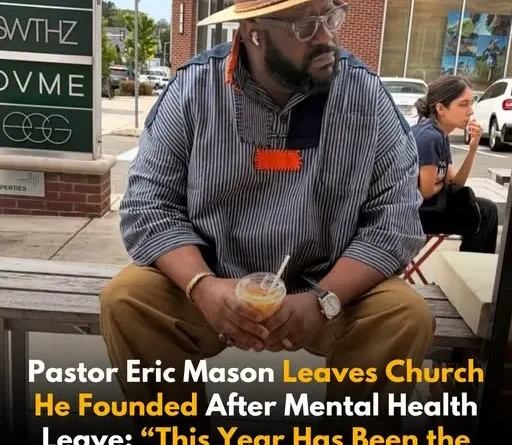
Dr. Eric Mason, who Unwisely Wrote the Book “WOKE CHURCH,” Has Left His Woke Church, Epiphany Fellowship in Philadelphia, due to Mental Health Issues
In November 2022, Daniel Whyte III Rebuked Eric Mason for Jumping the Gun and Unwisely Writing the Book “WOKE CHURCH” on the Trending Subject of Wokeism, Which Whyte Calls “Deceptionism” . . .
Dr. Eric Mason, who Unwisely Wrote the Book “WOKE CHURCH,” Has Left His Woke Church, Epiphany Fellowship in Philadelphia, due to Mental Health Issues. Daniel Whyte III believes that Dr. Eric Mason may be suffering depression from Wokeism, as so many of the people he led to Wokeism are. According to a large-scale academic study from Finland, “woke individuals are more likely to be unhappy, anxious, and depressed than other people.” Therefore, Daniel Whyte III encourages Brother Eric Mason to confess his sins, repent of his sins, go back to his church, apologize to the church and the nation for writing and preaching Woke bullsheep, get back on the firing line, get back to the old landmarks, and get back to preaching the Book, the Blood, and the Blessed Hope, as he used to, and he will be healed of his Nebuchadnezzar syndrome within 30 days or less, in the name of Jesus. Brother Eric Mason knows that Bible-believing preachers do not quit the ministry; they preach through the hell they are going through and come out on the other side victorious through Jesus Christ.
In November 2022, Daniel Whyte III Rebuked Eric Mason for Jumping the Gun and Unwisely Writing the Book “WOKE CHURCH” on the Trending Subject of Wokeism, Which Whyte Calls “Deceptionism” in his 40+ Sermon Series Titled “Wokeism: The Blob of Beelzebub.”
Beyond Woke: Why Biblical Truth Must Trump Cultural Trends in the Church
Deceptionism Unmasked: A Call for Biblical Clarity Over Woke Ideology
Jumping the Gun on Wokeism: A Critical Review of Eric Mason’s “Woke Church”
Woke or Biblical? A Sobering Examination of Race, Identity, and the Gospel
The Bait of Wokeism: Why Pastors Must Prioritize Scripture Over Social Justice Trends
One Identity in Christ: Dismantling the Faulty Premises of “Woke Church”
Don’t Be Woke, Be Biblical: A Critical Look at Race and Reconciliation
Wokeism: The Blob of Beelzebub or Just Deceptionism?
Race, Rhetoric, and Redemption: Rebuking the “Woke” Agenda in the Church
The Danger of Cultural Captivity: Why “Woke Church” Misses the Mark
From Dr. Eric Mason
Pastor and author Eric Mason has announced that his time at Epiphany Fellowship Church in Philadelphia has come to an end after more than 20 years in the city.
“This year has been the hardest year of my life,” Mason said. “I’ve been on medical leave for my mental health. I’m still healing and recovering, but some changes are on the way.”
Mason expressed gratitude for everything God accomplished during the family’s years in Philadelphia and asked for prayer as they enter a new season.
“Pray also for my continued healing and peace,” he wrote, “remembering I’m YHWH’s son first, a husband, father, and minister of the gospel—in that order.”
BLACK CHRISTIAN NEWS is a reader-supported publication. To receive new posts and support my work, consider becoming a free or paid subscriber.
In November 2022, Daniel Whyte III Rebuked Eric Mason for Jumping the Gun and Unwisely Writing the Book “WOKE CHURCH” on the Trending Subject of Wokeism, Which Whyte Calls “Deceptionism” in his 40+ Sermon Series Titled “Wokeism: The Blob of Beelzebub.”
Alex Kocman, who is white but deeply invested in the Black community as the father of a Black son, lovingly and respectfully dismantles Eric Mason’s book Woke Church in his review, “You Don’t Need to Be Woke to Be Biblical: A Review of Eric Mason’s Woke Church on Race.”
Daniel Whyte III, president of Gospel Light Society International, says Eric Mason is a smart man. However, Whyte believes he got deceived, took the bait, and foolishly jumped the gun on the trending topic of Wokeism—which has caused great confusion and pain in Black-white church relations within Protestant, Evangelical, Baptist, and Bible church communities. Like many other pastors, both Black and white, Mason only saw one side of Wokeism (or what Whyte calls “Deceptionism” in his sermon series “WOKEISM: THE BLOB OF BEELZEBUB”). As we now know, wokeism is far bigger than race; race was merely used as bait by the “Woke Meisters” to get undiscerning and unwise pastors to bite and lend support to the demonic, destructive movement. Wokeism is far more detrimental to the church—and to the young people it has destroyed—than many initially thought.
Alex Kocman said, “Only a few brave souls darken the door of my gym at 6:00 a.m., so us regulars know one another’s faces pretty well.
Several weeks ago, I had a curious exchange with one such fellow addict, Amir (name changed). An early-middle-aged, outgoing, husky, black man, he sports an ‘In God We Trust’ tattoo on his forearm and can often be seen in his characteristic white tee and gray sweatpants pacing back and forth between the benches and the abdominal machines, performing his ritual supersets. I took it upon myself to get to know him and steer the conversation towards spiritual things, asking about his Islamic name.
Loudly and excitedly, my new friend proceeded to explain how throughout his childhood he bounced between church and mosque only to decide that they were all ‘saying the same thing.’ His faith, he offered, is essentially one of self-determination and disciplined, moral living (one-third of the American trifecta consisting of baseball, apple pie, and moralistic therapeutic deism).
I began to press on the uniqueness of the Jesus of the Bible in distinction from the Isa of Islam. Amir’s response was striking. Speaking of the Bible, he retorted, ‘I can’t devote myself to a book that has been used to oppress blacks and justify slavery.’
On its face, his sentiment is understandable. The historic silence of many American Protestant denominations and institutions on issues of race and slavery is a repugnant blight on our gospel witness. But the same argument could be used against the Qur’an, which was used to justify the heinous Arab and North African slave trade perpetrated until very recently. (For instance, only since 2007 has it been possible to prosecute slaveowners in Mauritania.) But the logic breaks down quickly. The abuse of a religion or text is no argument against its use.
Why this anecdote? Amir isn’t the only one making such arguments. I suspect men like him were among those in mind for Dr. Eric Mason as he penned Woke Church (Moody, 2018).
As the title suggests, Woke Church is intended as a rallying call to American churches—particularly those of us who are more of the melanin-challenged variety—to take seriously the plight of blacks in America, reappropriating the lingo of #BlackLivesMatter and similar trends in service of a Christian social ethic.
In spite of its politically polarizing title, Mason spends the majority of the book making a number of observations with which both sides of the social justice debate can agree, from his decrying of the general apathy of many suburban churches to his salient condemnations of police brutality. The book offers readers a pulse on the felt needs facing the black community through the eyes of an urban, Calvinistic church planter, and most fair-minded readers can happily nod along with many of Mason’s broad statements about neighbor-love, empathy, and missional living.
And therein lies the problem of the book. One does not have to be ‘woke’ to embrace the biblical imperative of love for neighbor. But by introducing a series of faulty terms, arguments, and assumptions inherited from the broader social justice movement, Mason undercuts his own case. Try as Mason may to redefine the term, woke is simply not a synonym for Christian charity, and his insistence otherwise dilutes the book into a trendy, politically correct pamphlet light enough to catch any passing sentimental breeze.
That said, one problem with the current social justice debate is that both sides fail to extend the judgment of charity. On one extreme, all the SJWs are thought to be closet Marxists; on the other side, anyone who questions the orthodoxy of racial reconciliation is a racist. My aim is to offer a grounded critique that avoids both ditches.
To that end, this review is divided into four serious critiques followed by some positive observations. My goal is neither to give a ‘hot take’ and rally one side, nor to kowtow to the eminent evangelicals on the ‘woke’ end of the spectrum; rather, my aim is simply to bring Scripture to bear upon Mason’s work and advance the conversation forward.
Critique 1: Misplaced Identities
At the root of racial reconciliation confusion is a failure to prioritize one’s identity in Christ over one’s belonging to a category, ethnic or otherwise, carved out for victim status.
Mason commits this error as early as page 23 in recounting a conversation between himself and his children while watching news footage reporting the enslavement and trafficking of Libyan refugees:
‘My eight-year-old son, Nehemiah, started crying. He said, “Who are these people?”
I said, “Son, these are our people.”
He said, “These are our people? Is this today?” He could not wrap his eight-year-old mind around it. He began to weep because he could not reconcile the idea of slavery in today’s age.
My son couldn’t believe that people of any kind would be enslaved, particularly people that looked like him. Nehemiah had never been to Libya. He had never met any of the people featured in the video that we watched, but they looked like him, and he immediately understood his connection to them. They were his people.’
Mason’s young son’s compassion is admirable, and we must all follow the Mason household’s example in rejecting apathy. But caught up in all this is a fallacious conflation of identities; Mason writes of his son that the Libyans were ‘his people’ (emphasis in the original), although the family had no connection to Libya. The underlying assumption is that a black family in Philadelphia is to maintain solidarity with Libyans not simply on the basis of the imago Dei—much less shared values, language, culture, or beliefs—but based on pigment.
But aside from the futility of assessing the motives of man-stealers half a world away, my concern is that Mason is confused about who the real ‘us’ is. For Mason, is ‘us’ the black community—not only in the U.S., but everywhere where people happen to possess darker pigment, even in cultures and societies where skin color doesn’t carry the same significance that it does on our shores? Would I be equally justified in telling my white daughter that ‘her people’ are really white Italians, Germans, Czechs, and Irishmen scattered across Europe, suffering all their injustices? Should I not instead encourage her to see the colorful collection of believers in the body of Christ in our own church that we attend each week as ‘her’ people, her brothers and sisters, her primary ‘us’—and then, by extension, the global body of Christ?
I am sure Mason affirms the communion of saints in the invisible church; however, when we swallow the world’s insistence that we divide into classes and categories—ethnic, economic, or otherwise—we undermine biblical anthropology and invite the sin of partiality into our midst.
This faulty logic betrays itself in various sections of the book. On page 43 Mason uses the words ‘we’ and ‘our’ to refer simultaneously to America as a whole as well as to the church: ‘[W]e must pursue honest reconciliation that faces the issues of our broken past in this country. We must take the time to revisit our history and proclaim the gospel to each season and seek reconciliation, restoration, and restitution, as is appropriate.’ While his sentiment is commendable, his confusing use of pronouns almost conflates American national identity and its accompanying historic sins with the renewed identity we receive in Christ as the covenant people of God. Though I doubt this was his intention, a greater level of precision and distinction would have strengthened his argument. Who needs to repent: unbelieving America, or the church of Christ—and for what? Precision matters.
Conversely, Mason throughout the book is actually at odds with himself on the issue of identity. To his credit, he writes, ‘We should feel more at home with people in the Christian family than our own ethnicity. In other words, the best part of our family should be those who have the same eternal blood type, not just the same physical blood type…. it grieves my heart to see that we so often treat each other like we’re from different bloodlines’ (66). This is the heart of the issue, and hopefully a proposition on which both sides of the racial reconciliation conversation can stand. We belong to the Christian family before we belong to any other family—white, black, or otherwise. In Christ there is no ethnic category that holds any weight in terms of our salvation or Christian fellowship (Colossians 3:11).
But then, in a reversal of tone on page 100, Mason bemoans the ills of even genuinely inclusive churches:
‘I fear that with all of the multiethnic congregations being former, we will lose the focus on engaging the systemic needs of blacks. Many times in multiethnic spaces, others get primacy and the needs of blacks are minimized. It almost feels like in order for the church to be one, blacks have to merge with whites as the standard church, then we spend the rest of our lives trying to “integrate” a system that wants us present, but is not willing to shape the central systems to make room for all people.’
The accusation is that even in ‘multiethnic spaces,’ some ethnicities have unique ‘systemic needs’ that aren’t being addressed. The solution, then, is to alter the systems and structures of the local church to favor certain ethnicities over others, thereby compensating for some imbalance presumably caused by the existence of the hegemonic ethnicity. Honest reflection on the content of the New Testament shows that this is utterly foreign to the apostolic faith.
Mason continues: ‘I fear that if we partner with whites that they will find a way to subjugate blacks and make us dependent on them in a way that kills our freedom of a truly black led institution.’ At the risk of stating the obvious, would Mason let this statement fly if the roles were reversed? Imagine saying: ‘I fear that if we partner with blacks, they will find a way to wrong whites in a way that kills our freedom to have a truly white-led institution.’ Such a statement would rightly be dubbed vile, racist hate speech. I am not making this statement; I am showing how absurd it would be to make.
Though we should not be so naïve as to think that creedally orthodox churches are incapable of partiality or prejudice—American history proves otherwise—to prescribe a system of blanket favoritism to compensate for past injustices undercuts the real, biblical basis of reconciliation: unconditional love (1 Corinthians 13:1-7) and forgiveness (Matthew 18:22). For the Apostle Paul, believers from all ethnic backgrounds are one in Christ, and their divisions no longer matter (cf. Galatians 3:28, Colossians 3:11). A believer is crucified with Christ, and his true self is hidden in the Son of God (cf. Galatians 2:20, Colossians 3:3). Any pastoral counsel that glosses over this glorious reality and stirs suspicion and fear of certain ethnic groups within the church invites people to commit the sin of partiality (James 2:1).
Critique 2: Faulty Definitions
Another crack in Mason’s foundation concerns faulty and naïve definitions of cultural buzzwords, which are themselves moving targets. Mason attempts to redeem the term ‘woke’ from the secular political left and breathe biblical meaning into it. While I’m all for taking dominion of the dictionary, the vernacular is what it is. Definitions matter. We cannot religiously retool the popular cultural lexicon without garnering suspicion or misunderstanding both within the church and the watching world.
The back cover defines woke this way: ‘able to understand how cultural, socioeconomic, philosophical, and historical realities inform our responsibilities as believers in Jesus Christ.’ If this is what it means to be woke, sign me up. But our vocabulary as creatures of the word must come to us by other means than baptizing the latest hashtag.
Mason acknowledges that the term derives from Pan-Africanists and Black Nationalists (p. 25), but immediately appropriates it as a synonym for Christian wakefulness (à la Ephesians 5:14). Commendably, Mason repudiates these racist groups and those like them, including the Black Hebrew Israelite movement; however, the problems presented by appropriating a politically charged term remain. On page 112, Mason makes reference to what it means to be ‘biblically woke’—a phrase as theoretically meaningless as ‘Christianly nationalist’ or ‘biblically Republican.’ What would happen if someone released a book titled Redneck Church, Conservative Church, Libertarian Church—etc.? However such terms are defined, their broad-brushed application (as an adjective modifying the very church of Jesus Christ) overshadows the best of authorial motives.
Mason also embraces fluid definitions of other terms more central to the social justice issue. Oppression is correctly defined on page 68 as ‘to exploit’ and ‘stopping others from being able to maximize and experience everything that God has made available to’ the one oppressed; however, this definition is interwoven with assumptions about privilege that equivocate possession of privilege with active exploitation. On page 132, Mason talks about the believer’s responsibility to address ‘inequities in our society’—conflating disparity with injustice, equality of opportunity with equality of outcome.
Mason also erects a blatant strawman definition of ‘colorblind’ (106):
‘[C]olorblindness denies God’s promise to Abraham that “in you all the nations shall be blessed” (Gal. 3:8 NKJV). It denies the Father’s promise to the Son that “I will also make you a light for the nations” (Isa. 49:6). It denies the Spirit’s promise to us that all the peoples will praise God (see Ps. 67:5). It denies Christ’s great commission to disciple the nations. It denies the Spirit’s work to prepare us for a multiethnic table…. Color-blind theology denies one of the main tenets of the historic Christian faith as outlined in the Apostles’ Creed: “I believe in the holy catholic Church.” Catholicity means precisely the opposite of colorblindness—celebrating the inclusion of all ethnicities in Christ. Colorblind theology denies Christ’s power to heal racial divisions, disparities, and injustices by ignoring their ongoing impact. Colorblind theology undermines unity in the church by refusing to acknowledge significant ethnic differences or address significant problems.’
Mason is absolutely correct that ethnic and biological diversity are part of both God’s glorious creative and redemptive designs. Believers cannot ignore each other’s unique burdens, struggles, and backgrounds, including those which relate to culture and ethnicity. However, the sense of the term ‘color-blind,’ as it has been recently employed, is simply that one should avoid prejudicial judgments of individuals based on the color of their skin, judging instead by the content of their character. That those in the ministry of so-called racial reconciliation find themselves, 50 years after Martin Luther King Jr., arguing against such an ethic is ironic and disheartening at best—and raises the question of exactly what sort of business they are in.
Critique 3: Shifting Standards of Christian Unity
Mason’s stated goal is gospel unity: ‘There will come a day when it won’t be based on ethnicity. It’s going to be based on you knowing Jesus…. That means everybody has to be equally cleaned by the blood of Jesus’ (174). While Mason is correct in his conclusion that we all stand equally in need of cleaning by the blood of the Lamb, his phrasing is strange: ‘There will come a day’ (emphasis mine). ‘Will’? Isn’t it already about knowing Jesus, not one’s skin color?
Amidst calls for gospel unity, Mason seems to mistake the aesthetic of diversity in heaven’s throne room for the basis of racial inclusion in Christ: ‘To say it plainly, God does care about color and ethnicity…. And the reason He singled you out is so that He could have representation of your people group in heaven!’ (170; emphasis mine).
Is Mason actually asserting that election is conditional upon race? While the unfolding mystery of Gentile inclusion is one of the shining gems of biblical revelation, to construe God’s decree of election as attempting to meet an ethnic quota in heaven does violence not only to our eschatology but our very soteriology.
Yes, Christ’s blood has ‘ransomed people for God from every tribe and language and people and nation’ (Revelation 5:9)—but not because God submits to the contemporary idol of stock-photo diversity. Rather, Revelation’s diverse throne room shows us the absolute indiscriminate nature of God’s lavish grace, extended unconditionally to Jews, Greeks, barbarians, Scythians, men, women, and the unreached at the ends of the earth. God is ‘no respecter of persons’ (Acts 10:34), and ‘the LORD sees not as man sees: man looks on the outward appearance, but the LORD looks on the heart’ (1 Samuel 16:7).
Critique 4: Counter-Intuitive Solutions
Critics of Mason may be encouraged by what they read in chapter 7, ‘A Vision for Change.’ While much of the broader ‘woke’ movement pushes for federally imposed reparations, Mason’s prescriptions are local, focusing on the home, the church, the neighborhood, the prison system, and the problem of fatherlessness in the black community. On the whole, Mason offers refreshingly family-oriented, church-driven solutions that stand in marked contrast to the political Left’s drumbeat of bureaucratic intervention.
However, some of Mason’s prescriptions whiz past the heart of the problem and continue, counter-intuitively, to exalt ethnicity to a central position in human identity. While Mason also affirms that culturally aware Christians should ‘dance’ with God’s law (54), most of his solutions draw more from simplistic sociology than exegesis. Mason simplistically advocates increasing the number of black teachers in the U.S., obscurely referencing a ‘growing body of evidence’ that ‘race affects how teachers see and treat their students’ (141). Though he joins this with an evangelistic strategy (’The Woke Church needs to interrupt the school-to-prison pipeline and speak the gospel into those students’ lives’ [141]), the two solutions are at odds with each other. We cannot preach a gospel of repentance from partiality in schools while simultaneously employing unequal scales, which the Lord hates (Proverbs 20:10), in hiring educators.
In an atmosphere in which many, in a sense of guilt, are encouraging affirmative action-type policies—even in selection of local church elders—Mason does denounce tokenism: ‘When blacks who lack significant expertise are given this kind of platform, it suggests that there is not authentic care for the subject matter…. Tokenism impacts whites as well. If an unqualified black man or woman is brought into a majority white space as a professional integrationist or just as a black presence to promote diversity, but lack the acumen for the role, it hurts’ (102). Unfortunately, Mason proceeds to lay the blame at the feet of insufficiently minority-conscious hiring practices, rather than attacking the larger issue of whether hiring decisions should be made at all on the basis of ethnicity.
Positives
Now, having thoroughly critiqued Mason, I would also like to highlight a few points in the book I find to be praiseworthy.
Mason is clear that God’s mission advances through the body of Christ, not the civil magistrate. He emphasizes regeneration, which many Christians often forget to do as soon as they enter public discourse. ‘You have to be intrinsically changed by God in order for justice to be done…. justice doesn’t come by legislation, because you can legislate things and nothing changes’ (50).
Let us state this even more strongly: real justice is impossible unless we are justified. Our gravest problem is not a lack of justice in society but our assurance of justice before the throne of God. Red and yellow, black and white, we all have enough personal and corporate sin to condemn us before a holy Judge. The gospel is not merely a program for social change, but the announcement that God in Christ is both just and the justifier of those who trust in the crucified and risen Savior (Romans 3:26). By faith, we receive the righteousness of Christ in place of both our inherited and individual guilt, making it possible for God to declare us righteous in his courtroom and free us from guilt and judgment.
Jesus really saves both repentant racists and the penitent oppressed (175). But apart from a sizable segment of our population experiencing this radical, heart-transforming grace, it is folly to dream of chiliadal harmony in our day.
In terms of his pastoral approach, Mason deftly encourages church leaders to adopt an empathic posture towards those experiencing pain or frustration due to racial discord. Comparing the current conflict to a spousal argument, he writes, ‘We can have empathy for one another even if we disagree, because love comes before agreement’ (69). This point is not lost on me as one of Mason’s more critical readers. Agreement on issues of culture, race, and social justice does not have to be a prerequisite for charity.
Conclusion
I feel it apt to return to my acquaintance Amir. A few weeks after our initial exchange, I approached him in another friendly effort to build a relationship and share Christ. After an exchange of friendly jests and jabs, the sort you often give and receive in the weight room, we found ourselves in another discussion about culture and current events.
Amir, a former drug dealer who has now built a successful business, reaffirmed his commitment to pull-yourself-by-your-own-moral-bootstraps soteriology. But as soon as the conversation shifted to societal issues, I was immediately struck by his change in posture.
Conceding societal and systemic sin, I pointed out that Adam, the head of our race, is the original source of sin that runs in all of our bloodlines, rendering us all guilty before God, white or black.
‘That’s your opinion,’ Amir countered. When I took him to Romans 5 to show him the headship of Adam in original sin and the headship of Christ for salvation, he ended the conversation abruptly, ‘You sound like a broken record.’
I am proud to be a broken record if my gospel is the gospel that cuts through excuses and resentments to get to the heart of the issue: my sin, Christ’s finished work, and the call to repent and believe.
It is always easier to be angry at someone else’s sin than our own. We cannot be ignorant of the way that the current social justice narrative deflects the gospel’s emphasis on my sin in favor of an emphasis on their oppression. Our gospel witness depends upon emphasizing our sin in Adam, Christ’s gift of righteousness to his people, and the call to personal faith that lives itself out in love of neighbor.
Contrary to Dr. Mason’s claims, we do not need to be ‘woke’ to care about suffering and injustice. By adopting the world’s lingo, we’re playing into a larger agenda that de-emphasizes the gospel of guilt, grace, and gratitude. We simply need to be biblical.”
https://www.youtube-nocookie.com/embed/TEvJmhDB3P8?rel=0&autoplay=0&showinfo=0&enablejsapi=0
<iframe src=’ https://widget.spreaker.com/player?episode_id=51986940&theme=dark&chapters-image=true’ width=’100%’ height=’200px’ title=’Wokeism: the Blob of Beelzebub / Standing Between the Living and the Dead Devotional Service’ frameborder=’0’></ifra
_________________________
Daniel Whyte III has been preaching the Gospel for over 46 years and is the founder and President of the over 42-year-old Gospel Light Evangelistic Society International, Pastor of the over 38-year-old Gospel Light House of Prayer International, and Founder, President, and Editor-in-Chief of the over 22-year-old Black Christian News One (BCNN1.com)—reaching millions with the Gospel of Jesus Christ, discipleship preaching, and the whole counsel of God around the world by any means necessary — “Crying in the Wilderness” and “Exiled on the Isle of Patmos.”
Daniel Whyte III was honored by being named one of the 17 most notable alumni in the history of the 134-year-old Texas Wesleyan University in Fort Worth, Texas, and one of the 69 most notable alumni in the history of the 53-year-old Liberty University in Lynchburg, Virginia.
Daniel Whyte III holds the following degrees from these universities:
- Doctor of Ministry (D.Min., in progress) – Liberty University John W. Rawlings School of Divinity, Lynchburg, VA
- Master of Theology (Th.M.) – Liberty University John W. Rawlings School of Divinity, Lynchburg, VA
- Master of Divinity (M.Div.) – Liberty University John W. Rawlings School of Divinity, Lynchburg, VA
- Bachelor of Arts in Religion (B.A.) – Texas Wesleyan University, Fort Worth, Texas
- Bachelor of Theological Studies – Bethany Divinity College and Seminary, Dothan, Alabama (Honors: Summa Cum Laude)
Daniel Whyte III was also honored to sit with presidents and world leaders by being invited by the Billy Graham Evangelistic Association to attend the homegoing of Dr. Billy Graham.
He is the Essence national best-selling author of Letters to Young Black Men and the Amazon best-selling author of Letters to Young Black Women (African-American category). He has authored over 100 books.
He is also the founder, president, and editor-in-chief of the 20-year-old BlackChristianNews.com (BCNN1.com), which has impacted every denomination in the evangelical and Christian world and has influenced presidents, the U.S. government, governments around the world, and the public square. BlackChristianNews.com has been named the #1 Black Christian website and blog in the world for four years running by the independent Feedspot and is on the list of the top 60 Christian news sites in the world—red, yellow, black, or white.
He has preached the Gospel and the Word of God in person across America and in over 24 countries to thousands of people. He has preached the Gospel and the Word of God to millions of people around the world with the help of the internet, preaching live and on-demand multiple times a day for over eight years, to this very day. His mottoes are “Crying in the Wilderness,” “Exiled on the Isle of Patmos,” and “Preaching the Gospel by any means necessary,” all for the glory of God and Jesus Christ.
Daniel Whyte III is the president of the over-40-year-old Gospel Light Evangelistic Society International and the over-37-year-old Gospel Light House of Prayer International. He is known worldwide as the prophet who predicted the Coronavirus Plague over 10 years before it hit in recorded preaching and writing. God also led him to guide thousands through the Coronavirus Plague that killed over 20 million people because of the sins in the Judas-Laodicean church.
Daniel Whyte III’s greatest blessing in this life is his “quiver full” of 10 children—Daniella (Danni), Daniel IV, Danita Evangeline, Danae Mary-Louise, Daniqua Grace, Danyel Ezekiel, Danyelle Elizabeth Breedlove, Danielle Tekeela, Duran-Daniel, and the first Daniel IV (deceased and in heaven with the Lord)—along with grandchildren and great-grandchildren.
Daniel Whyte III has been unblissfully but sexually satisfyingly married to his first and only wife, Meriqua Whyte of Christiana, Jamaica, for over 37 years since December 19, 1987. Jesus Christ said: “And a man’s foes shall be they of his own household.” Even though many evangelicals, charismatics, and Protestants try to act as if these words of Jesus Christ are not a reality in our modern Christianity—primarily because of the Satanic-driven prosperity gospel and an over-positive philosophy, which is a lie not based in reality or biblical truth—the words of Jesus Christ are true for every person who preaches the Gospel. The outcomes of the Gospel are a changed life and opposition from family, lukewarm Christians, Laodicean-Judas pastors and churches, the world, and the devil. This is a reality in our present evil world.
While Daniel Whyte III thoroughly enjoys his married life because he did not allow his wife to have her way at any point and was and is solidly and biblically the head of his household throughout the marriage—often quoting Joshua, “As for me and my house, we’re going to serve the Lord” “up in here!”—and because his wife never failed in the very important area of sex, which he got married for in the first place to avoid sinning against God, he has especially enjoyed the privilege and joy of raising his children in the Lord virtually by himself. He served the Lord with them every day of their lives, from the time they were born until they graduated from college, became adults, and moved on.
However, his wife, Meriqua Whyte—motivated by Satan, with a Pharaoh-style pride mixed with the well-known female Jamaican-style pride, stubbornness, rebelliousness, and witchcraft—has been his greatest Judas enemy in the world and has been what Paul spoke of: a “messenger of Satan” and a “thorn in the flesh.” Amazingly, and by the grace of God, that Satanic evil opposition has spurred Daniel Whyte III on to preach the Gospel probably more times than any man on record. God has honored him because he did not “hearken to the voice of his wife.” Whyte tells other Christian men to only hearken to the voice of God and Jesus Christ—not to their wives, as so many thousands of church men have been taught by pastors and other older men throughout the years. Remember, we are in this worldwide, multi-generational mess because Adam hearkened to the voice of his wife and not to the voice of God.
Before they were married, Daniel Whyte III told his wife Meriqua Whyte that they would not do family life as her parents did, because their married life was hellacious and ended in divorce, as did some of her other family members, including the aunt she was living with. He also told his wife they would not do family life as his parents did, because it was also hellacious and out of order since his mother was the head of the household, not his father. But thanks be to God, they never got a divorce. Whyte told his wife before they got married that they were going to do it God’s way according to Ephesians chapters 5 and 6, or no way at all. And then he asked his wife, “Are you willing to do marriage God’s way according to Ephesians chapters 5 and 6?” And she said yes. Whyte told her before they got married that if she did not live up to her end of the deal, all bets were off.
Because Daniel Whyte III’s wife, Meriqua Whyte, was so proud, unsubmissive, stubborn, and rebellious after they got married, God led him to read Ephesians chapters 5 and 6 every day in their family devotions throughout their marriage. In the first year of their marriage, Daniel Whyte III also gave his wife a list of verses for women from the Word of God for her to read, which she still reads to this day. He also bought her many books to read to help her be the wife God wanted her to be.
Whyte realized early in the marriage that his wife was not a born-again, saved person even though she lied and said she was before they got married. After over 37 years of marriage, she is still not saved, never bearing any fruit of a saved person, to the point of not even wanting to tell her children, “I love you” and not wanting to hug them when they were little children, even after her husband told her to do so. She also hated the daily family devotions that her husband led and tried to hinder them. She also demonically hated and tried to hinder every Gospel preaching service to this very day.
However, only by the grace of God, they are still married, and despite the devil constantly working through his wife to try to hinder him from preaching the Word of God, he is still preaching the Gospel and the Word of God live and on-demand. His ministry reaches over 148,800 people per month with over 21,000 unique views per month, reaching 149 countries, preaching the Gospel and the Word of God in 2 to 3 services a day, 7 days a week. Glory be to God!
Mrs. Meriqua Whyte’s Apology to her Husband and Their 7 Children for not Being a Biblical Wife or Mother
Mrs. Meriqua Whyte, the Wife of Daniel Whyte III, Gave him the Best Father’s Day Gift Ever About 10 Years Ago When She Unexpectedly and Voluntarily Apologized for the First Time to Him and Their 7 Children for Not Being the Wife, Mother, and Christian Example of the Woman She Should Have Been Over the Past 37 Years of Marriage
Here is what Mrs. Meriqua Whyte wrote ten years ago after verbally apologizing to the entire family on Father’s Day, right before church service:
Over thirty years of marriage. Over thirty years of ups and downs. Over thirty years of trying to make our problems a personal thing between my husband and me. Thankfully, he did not allow me to do that and kept telling me it was between God and me—over thirty years of acting on my feelings and not on what the Bible says. Over thirty years of refusing to obey God’s simple command to a wife—to be obedient to your husband in all things. Over thirty years of disobedience, rebelliousness, stubbornness, lying, and dishonesty, all rooted in pride. Over thirty years of simply not choosing to mature as a Christian.
God has been dealing with me for over thirty years now about changing my attitude and behavior as a wife, which has manifested itself in disobedience, rebelliousness, stubbornness, lying, dishonesty, having an ungodly attitude and spirit, and simply not being the wife, mother, or example of a Christian woman that I should have been throughout the years. (By the way, for those of you who may be thinking that my disobedience, rebelliousness, stubbornness, lying, and dishonesty have resulted in adultery, I will say here that I have never committed any adultery or had sex with another man besides my husband, Daniel Whyte III, since I was born.)
God kept telling me I needed to stop my rebellious and stubborn behavior, apologize to my husband and children, and get my heart right with him, my husband, and my children. He sent others my way to tell me how to behave:
- My husband, but I didn’t want to hear it from him
- Other Christian women speakers
- Other preachers
- Books and other materials, but I would not take heed
I knew what to do, but I chose not to do it. The devil had me thinking and believing—as he is having a lot of wives and mothers think and believe—that your relationship with your husband and how you respond to him, whether positive or negative, will not affect your relationship with your children or your relationship with God. I say without hesitation that this is one of the devil’s lies, and sad to say, many wives and mothers are falling for this lie.
Another lie of the devil that Christian wives are falling for is that you can still have a strong relationship with God without being submissive to your husband. Lie! Lie! Lie! There is no truth to this. I know because I have experienced this and am still experiencing this as I am going through this breaking process, which is not happening overnight.
Even throughout my years of rebelliousness, stubbornness, and pride, I still kept praying the prayer I used to pray daily before I got married: “Lord, make me be exactly what You want me to be. Lord, break, make, and mold me into what you want me to be.” Well, God took that prayer seriously, and once you accept Him, He will begin the breaking process. It’s up to us how long that breaking process will take. For me, sad to say, it has taken over 30 years, and the breaking is not complete. In what way is God breaking me down right now? Well, our children have grown up. The three oldest have gone through and are still going through college, have gotten their degrees, and some are working on their second, third, and fourth degrees, launching their careers and moving out. God slapped me into reality and truly intensified the breaking process. My husband told me before our first child was born and repeatedly while the children were young that my job was to love our children and make positive memories with them and that if I did that, I would have a wonderful relationship with them as adults in the time to come. Well, I disobeyed God and my husband, who did not let up on his duties. And he has a wonderful relationship with our children, even the girls, and I don’t. However, God led me to finally break the day before Father’s Day, and while I was helping my husband get dressed to preach, I asked him if I could apologize to him and the entire family. That’s the first time I ever did that on my own. Throughout the years, he has always told me that I needed to get my heart right with God, him, and my children; otherwise, I would never have the joy and peace of the Lord in my life. However, I kept on lying and denying that I was the problem.
Here is what I said to my husband and children on Saturday afternoon, June 17, 2017, the day before Father’s Day. My husband told the entire family that this was the best Father’s Day gift I have ever given to him:
“Daddy, children, I apologize for not being the wife, mother, and example of a Christian woman I should have been throughout the years. I have shown nothing but pride, disobedience, rebelliousness, stubbornness, and a bad attitude and spirit toward God and my husband in front of you. My disobedience and rebelliousness have caused much unnecessary unrest and upheaval in the family. As my husband told me, things could have gone much better if I had obeyed God’s word from the beginning. Please accept my apology, and I am asking you to forgive me.”
The diminishing of peace and joy in my life throughout the years I brought on myself. Not having a proper relationship with God, my husband, and my children, I brought on myself—all because I chose the disobedient route. My number one desire is to live a life of peace—peace with God, my husband, and my children. I have learned that peace will not come as long as I live in disobedience, rebelliousness, stubbornness, and pride.
I will end this with two notes: (1) Happy Father’s Day to my husband: you have been a great husband and father. (2) Happy Children’s Day to my children: You all have been great children. I have no complaints whatsoever against my husband and, of course, children; you have never been at fault. My bad behavior is all on me, and I’m sorry I put you through this. May God bless your lives, and I love you.
Ephesians 5:22 – 6:20 (KJV)
Below is the passage in the Bible that Daniel Whyte III read in their family devotions every day for decades. It covers the biblical duties of the husband, the wife, and the children, and includes how to fight against the devil who is seeking to destroy the family.
22 Wives, submit yourselves unto your own husbands, as unto the Lord.
23 For the husband is the head of the wife, even as Christ is the head of the church: and he is the saviour of the body.
24 Therefore as the church is subject unto Christ, so let the wives be to their own husbands in every thing.
25 Husbands, love your wives, even as Christ also loved the church, and gave himself for it;
26 That he might sanctify and cleanse it with the washing of water by the word,
27 That he might present it to himself a glorious church, not having spot, or wrinkle, or any such thing; but that it should be holy and without blemish.
28 So ought men to love their wives as their own bodies. He that loveth his wife loveth himself.
29 For no man ever yet hated his own flesh; but nourisheth and cherisheth it, even as the Lord the church:
30 For we are members of his body, of his flesh, and of his bones.
31 For this cause shall a man leave his father and mother, and shall be joined unto his wife, and they two shall be one flesh.
32 This is a great mystery: but I speak concerning Christ and the church.
33 Nevertheless let every one of you in particular so love his wife even as himself; and the wife see that she reverence her husband.
6 Children, obey your parents in the Lord: for this is right.
2 Honour thy father and mother; which is the first commandment with promise;
3 That it may be well with thee, and thou mayest live long on the earth.
4 And, ye fathers, provoke not your children to wrath: but bring them up in the nurture and admonition of the Lord.
5 Servants, be obedient to them that are your masters according to the flesh, with fear and trembling, in singleness of your heart, as unto Christ;
6 Not with eyeservice, as menpleasers; but as the servants of Christ, doing the will of God from the heart;
7 With good will doing service, as to the Lord, and not to men:
8 Knowing that whatsoever good thing any man doeth, the same shall he receive of the Lord, whether he be bond or free.
9 And, ye masters, do the same things unto them, forbearing threatening: knowing that your Master also is in heaven; neither is there respect of persons with him.
10 Finally, my brethren, be strong in the Lord, and in the power of his might.
11 Put on the whole armour of God, that ye may be able to stand against the wiles of the devil.
12 For we wrestle not against flesh and blood, but against principalities, against powers, against the rulers of the darkness of this world, against spiritual wickedness in high places.
13 Wherefore take unto you the whole armour of God, that ye may be able to withstand in the evil day, and having done all, to stand.
14 Stand therefore, having your loins girt about with truth, and having on the breastplate of righteousness;
15 And your feet shod with the preparation of the gospel of peace;
16 Above all, taking the shield of faith, wherewith ye shall be able to quench all the fiery darts of the wicked.
17 And take the helmet of salvation, and the sword of the Spirit, which is the word of God:
18 Praying always with all prayer and supplication in the Spirit, and watching thereunto with all perseverance and supplication for all saints;
19 And for me, that utterance may be given unto me, that I may open my mouth boldly, to make known the mystery of the gospel,
20 For which I am an ambassador in bonds: that therein I may speak boldly, as I ought to speak.
The Gospel in a Nutshell
If you were to die today, where would you go: Heaven or Hell? If you’re not sure, “Believe on the Lord Jesus Christ, and thou shalt be saved.”
Jesus Christ said the most important words ever spoken in the history of the world when He said, “For God so loved the world, that he gave his only begotten Son, that whosoever believeth in him should not perish, but have everlasting life.” (John 3:16)
Read further right here:
The Most Important Question in the World: Have You Been Twice Born?
This is the “Chief of sinners,” Daniel Whyte III, president of Gospel Light Society International, with the Gospel Light Minute X Podcast #447, titled, “The Big Question.” I’m here to remind you of what the Bible says: that “Christ Jesus came into the world to save sinners” like you and me.
“Have You Been Born Again?”
The question is not, “Have you joined a church?” or “Are you trying to do your best?” or “Do you have religion?” but, “Are you twice-born?” Jesus Christ said in John 3:3, “Except a man be born again, he cannot see the kingdom of God.”
We enter the physical world by birth. Spiritual life, likewise, is entered with a birth. We become members of a human family by birth; we become members of the family of God by birth, by being “born again.” There is no other way to get into the human family except by birth, and there is no other way to get into God’s family except by the new birth. Neither education, nor cultivation, nor reformation, nor “turning over a new leaf,” will accomplish this. What is needed is not a new “leaf” but a new “life”! “Ye must be born again” (John 3:7).
A New Nature Needed
By physical birth, we become partakers of human nature; by being born again, we become “partakers of the divine nature.” A Christian is the product of a divine “begetting.” The second birth is not an improvement of the old nature; it is the imparting of an entirely new nature. The old nature is hopelessly corrupt and incapable of ever being made fit for His presence. The new birth requires a creative act of the Holy Spirit. “If any man be in Christ, he is a new creature.”
Not “Trying” But “Trusting”
“Trying to follow Christ” is not Christianity. Christianity is not imitation of Christ; it is the indwelling of Christ. Christianity is not trying to do anything. It is trusting Christ, who has done it all! He has “finished the work,” and there is nothing left to do but simply to receive and trust Him. He shed His precious blood on the cross, and the work is all done once and forever! Cease trying and begin trusting! Believers will progressively become more and more like Christ, but by His power, not their own.
What Must I Do To Be Saved?
Simply “Believe on the Lord Jesus Christ.” The Bible says in 1 John 5:1, “Whosoever believeth that Jesus is the Christ is born of God.” The Bible states in John 1:12-13, “As many as received him, to them gave he power to become the sons of God, even to them that believe on his name: Which were born, not of blood, nor of the will of the flesh, nor of the will of man, but of God.”
You are born again, you become a Christian by trusting a Person—receiving a Person. The very moment you do this, the Lord Jesus Christ comes in and life begins!
What Is Meant By “Believe”?
To “believe on the Lord Jesus Christ” means more than simply believing the historic facts concerning Him. Intellectual belief about Christ is not sufficient. The belief that brings salvation must be “with the heart,” that is, with the whole being. This belief also includes repentance: “Repentance toward God, and faith toward our Lord Jesus Christ.” The Bible states in Acts 17:30, “God… now commandeth all men everywhere to repent.”
The faith which saves, then, includes the necessity to repent and to receive Christ as Savior and Lord, to rest upon Him alone for salvation. It means to trust Him so utterly and completely that, if He should fail, there would be no hope at all!
May I Know That I Am Born Again?
This is an important question. We know that we are born again by the testimony of God’s Word. God says in John 5:24, “He that heareth my word, and believeth on him that sent me, hath everlasting life, and shall not come into condemnation; but is passed from death unto life.” Have you believed on the Lord Jesus Christ as explained by God’s Word? If so, then you are saved, you are “born again,” you have “passed from death unto life.” God says so! Take God at His Word, and go on your way rejoicing!
One Final Word
You may “belong to a church,” you may be “trying to do the best you can,” you may be “striving to live right.” Your outward life may be the model of moral correctness, and you may be looked up to, honored, revered, and respected. Yet, if you have not been “born again,” you are just as lost as if you had never heard of Christ. Yes, you may teach in the Sunday school, read the Bible, sing, shout, “feel happy,” and all the rest—but if you have never been “born again,” you are still in your sins and a stranger to the Lord Jesus Christ.
If you want to be saved from the wrath to come and from an eternity in Hell, and if you believe that Jesus Christ suffered, bled, and died on the cross for your sins, was buried, and rose again from the dead, and you are willing to trust Jesus Christ with all of your heart so you can go to Heaven, please pray with me what is called the sinner’s prayer:
Holy Father God, I acknowledge that I am a sinner and I admit that I have sinned against You and that I have broken Your Ten Commandments. I have lied before. I have stolen things before. I have lusted after people and things before. I have dishonored and disobeyed my parents. I have taken Your holy Name in vain. For Jesus Christ’s sake, please have mercy and grace upon my soul and forgive me of all of my sins, my failures, and my faults. As I now believe in Your Holy Son, the Lord Jesus Christ. I believe that He suffered, bled, and died on the cross for my sins, was buried, and rose again. Lord Jesus, please come into my heart and save my soul and change my life. Fill me with Your Holy Spirit and help me to repent of my sins past. Help me to turn from my old, evil life and follow You in the new life. For it is in Your Name I pray. Amen.
SUPPORT THIS GREAT MINISTRY BY PURCHASING THE BOOKS BELOW: BESTSELLING BOOK LETTERS TO YOUNG BLACK MEN AND LETTERS TO YOUNG BLACK WOMEN BY DANIEL WHYTE III. ORDER IT FOR AS MANY YOUNG BLACK MEN IN YOUR LIFE AS POSSIBLE FOR THE GLORY OF GOD.